
What Size Electrical Panel Do I Need? 100 vs. 200 vs. 400 Amps in Northern California

Choosing an electrical service size is not about buying the biggest panel available. It is about matching the home's present demand, planned equipment, service condition and utility connection to a coordinated design. This guide compares 100-, 200- and 400-amp-class service and explains how Northern California homeowners can plan confidently.
Author: Chelsey Jones | Technical review: Legacy Electrical & Construction – CSLB #1058494 (B & C-10)
QUICK ANSWER The right electrical service size is determined by a load calculation – not square footage alone. A 100-amp service may support a modest home with limited electric loads. A 200-amp service is common when planning EV charging, heat pumps, electric cooking, an ADU or other additions. A 400-amp-class service is generally reserved for large or complex properties with substantial simultaneous demand. Equipment, utility capacity and future plans must be evaluated together.
Key Takeaways
Service amperage and the number of breaker spaces answer different questions.
Square footage is an input, not a complete sizing method; actual and planned loads matter more.
A 100-amp service is not automatically obsolete, and a 200-amp service is not automatically required.
A subpanel creates distribution space but does not increase the utility service capacity.
EV charging, ADUs, heat pumps and other major loads should be planned together.
Load management may preserve an existing service in some homes; other projects require a coordinated service upgrade.
PG&E, the local jurisdiction, equipment configuration and utility infrastructure can affect the approved design and schedule.
Table of Contents
Service Size Is a Planning Decision
An electrical panel often becomes part of the conversation when a homeowner wants to add something: an EV charger, ADU, heat pump, electric water heater, induction range, pool, spa, workshop, solar array, battery or generator. Each project may look separate, but all of them depend on the same electrical system.
The number printed on the main breaker matters, but it does not answer the full question. A useful recommendation also considers the condition and rating of the equipment, the service conductors, available breaker spaces, grounding and bonding, the home's current loads, the equipment planned for the next several years and the utility infrastructure serving the property.
The goal is not to choose the largest number by default. The goal is to build a safe, permitted plan with enough capacity and practical flexibility – without paying for equipment or utility work the property is unlikely to need.
SAFETY FIRST Do not remove a panel cover, touch service conductors or work inside energized equipment to identify your service size. If the enclosure is damaged, hot, buzzing, scorched or giving off a burning odor, keep clear and contact a qualified electrician. Call 911 for smoke, active arcing or fire.
What Do 100, 200 and 400 Amps Actually Mean?
The service rating describes the electrical system's designed current capacity. Homeowners commonly see that rating associated with the main breaker, but the complete service includes more than one component.
Main breaker: The primary overcurrent device that can disconnect power to the home's distribution system.
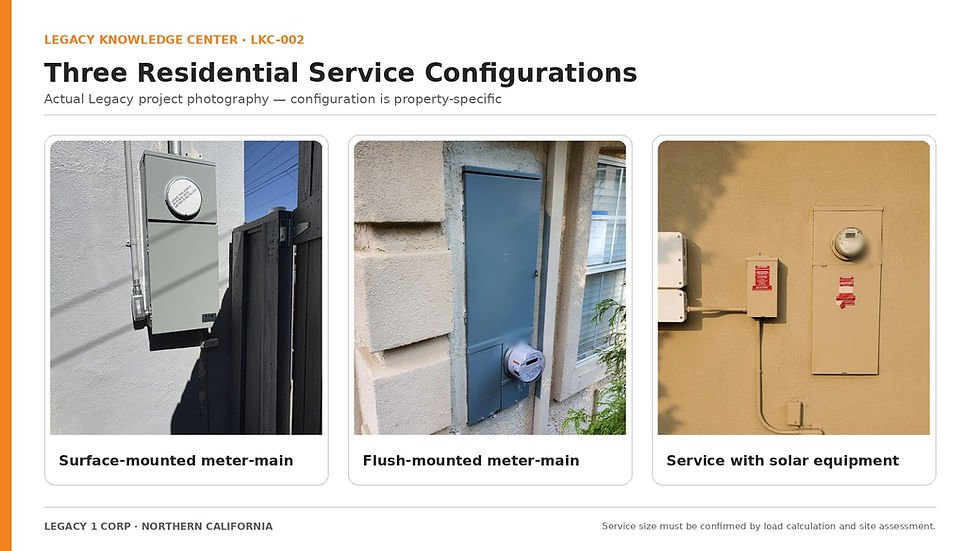
Meter-main: Equipment that combines the utility meter position with the main disconnect or distribution equipment.
Panel bus rating: The rating of the internal conductors that distribute power to breakers.
Service conductors: The conductors that carry power between the utility connection, meter and service equipment.
Breaker spaces: Physical positions for circuit breakers. Spaces affect how circuits are organized, not how much utility service capacity exists.
Those ratings must work together. A larger enclosure or more breaker spaces does not, by itself, increase the service available from the utility. Likewise, adding the numbers printed on every breaker does not determine the required service size. Electrical calculations apply demand rules because connected equipment does not always operate at full output at the same time.
The phrase 400-amp service also needs context. In residential work, it may refer to a 400-amp-class design using utility-specific 320-amp continuous-duty metering and more than one distribution panel. The actual meter, disconnect and panel configuration must be confirmed for the project rather than assumed from the nickname.

How Do I Know What Size Electrical Service I Have?
With the cover closed and the equipment in good condition, look for the amperage printed on the main-breaker handle and the manufacturer's label. A main breaker marked 100 or 200 is a useful first clue. Some homes have a separate exterior service disconnect and interior distribution panel, so the largest breaker you see indoors may not be the service rating.
A professional may need to verify the label, main disconnect, bus rating, service conductors and meter equipment together. That step is especially important when equipment has been modified, labels are missing, multiple panels are present or a planned project will add significant load.
100 Amp vs 200 Amp Panel vs 400-Amp Class: Side-by-Side Comparison
For most homeowners the question starts as 100 amp vs 200 amp panel; the 400-amp class is a separate project category. The comparison below shows where each service class may fit and what has to be evaluated before any of them is recommended.

Service Class | Where It May Fit | Planning Perspective | Required Evaluation |
100 amps | Existing homes with modest calculated demand and limited major electric loads | May remain appropriate when equipment condition, spaces and the future plan support it | Load calculation, equipment condition, future loads and service conductors |
200 amps | Homes adding several modern electric loads or needing more distribution capacity | Provides broader planning flexibility but is not automatically required | Load calculation, panel and bus configuration, EV/ADU/HVAC plan and utility service |
400-amp class | Large or complex properties with substantial simultaneous demand, multiple structures or extensive equipment | May involve utility-specific metering and multiple distribution panels | Detailed engineering, PG&E infrastructure, service route, metering and project-specific pricing |
These are planning contexts, not sizing rules. A site-specific load calculation and utility review determine the appropriate service design.
Why Square Footage Alone Does Not Determine Panel Size
Two homes with the same floor area can have very different electrical demand. One may use gas for space heating, water heating and cooking, charge no electric vehicles and have no planned addition. The other may have two EVs, a heat pump with auxiliary heat, electric water heating, induction cooking, a pool and a future ADU.
Square footage contributes to general lighting and receptacle calculations, but it does not capture the complete equipment list, fuel mix or simultaneous-use pattern. That is why a chart that assigns 100, 200 or 400 amps based only on home size can produce the wrong recommendation in either direction.
The same caution applies to the common whole-service “80 percent” shortcut. Continuous-load rules apply to specific loads and overcurrent-device sizing. They do not mean every 100-amp dwelling service has only 80 amps of universally usable capacity or every 200-amp service has only 160 amps. Residential service sizing uses code calculation methods, demand factors and project-specific inputs.
How an Electrical Load Calculation Works
A residential load calculation is a code-based evaluation of the demand the home is expected to place on its electrical service. It is more disciplined than adding breaker handles, reading last month's utility bill or entering square footage into a generic online calculator.
A qualified professional generally works through five steps:
Document the existing system. Record the service equipment, distribution panels, major appliances, HVAC, water heating, cooking equipment and other fixed loads.
Calculate present demand. Apply the adopted electrical-code method and applicable demand factors instead of assuming every connected load runs at full output simultaneously.
Add known future loads. Include the actual equipment being considered for EV charging, an ADU, heat pumps, electric water heating, a pool, workshop or other additions.
Test practical options. Compare the existing capacity, a service increase, equipment choices, managed charging, load controls or phased work.
Confirm the design path. Coordinate the equipment configuration, local permit requirements and PG&E service process before installation.
Monitoring data can help describe how a home currently uses electricity, but it is not automatically a substitute for the calculation and documentation required for a permitted design.

When 100-Amp Service May Still Be Enough
A safe, code-compliant 100-amp service is not automatically obsolete. It may remain appropriate for a home with modest calculated demand, limited major electric loads and no near-term plan that materially changes the load profile.
Capacity is only one part of the decision. The equipment must also be in suitable condition, have an acceptable configuration, provide the circuit space needed for planned work and be supported by appropriate conductors, grounding and bonding. A home can need a panel replacement because of condition or configuration even when a service increase is unnecessary.
Keeping 100 amps can be a sound result when the calculation supports it. It should be a verified decision, not an assumption made because the home has “always worked fine.”
When 200-Amp Service Often Makes Sense
Two hundred amps is a common planning level for homes adding several electric systems or undergoing a major remodel. Combinations of EV charging, a heat pump, electric water heating, electric cooking, an addition or an ADU can make the flexibility valuable.
That does not make 200 amps a universal requirement. The charger rating, HVAC design, water-heater choice, existing fuel mix and load-management strategy all affect demand. A 200-amp main also does not resolve every design question: breaker spaces, panel bus ratings, solar interconnection, battery equipment and utility capacity still require separate review.
When a 400-Amp-Class Service May Be Appropriate
A 400-amp-class residential service is generally a project category, not the next automatic step after 200 amps. It may be appropriate for a large or complex property with multiple dwellings or structures, extensive HVAC, a pool and spa, workshop equipment, several EVs or other loads expected to operate at the same time.
Higher-capacity work can involve multiple distribution panels, larger service equipment and a utility-specific metering arrangement. It can also expose infrastructure questions outside the home: transformer capacity, overhead or underground routing, trenching, service distance, easements and utility engineering.
For that reason, the feasibility, configuration, cost and schedule must be developed for the property. A generic square-footage threshold or online chart is not enough.
Plan Future Loads Together
The most efficient time to discuss future electrical demand is before equipment is purchased and before one project locks the next project into a poor design. Create a three-to-five-year property plan and bring it to the electrical assessment.
Planned System | Information to Bring Into the Assessment |
EV charging | Vehicle plans, charger rating, charging window, number of vehicles and whether managed charging is acceptable |
ADU or addition | Preliminary floor plan, appliances, HVAC, water heating and proposed meter/service arrangement |
HVAC and water heating | Equipment cut sheets, backup or auxiliary heat and the fuel source being replaced |
Cooking and laundry | Range, oven, cooktop and dryer ratings, including planned fuel conversions |
Pool, spa or workshop | Pump, heater, welder, compressor and other equipment ratings plus expected simultaneous use |
Solar, battery or generator | System size, interconnection concept, backup loads, transfer equipment and required disconnects |
Solar generation does not automatically increase the utility service capacity available to the home. Battery storage and backup systems can change how power is managed, but they also add equipment, interconnection and control requirements. These systems should be designed with the service – not bolted on as unrelated projects. For a deeper look at those systems, see EV charging and battery storage planning.


Can Load Management Avoid or Delay a Service Upgrade?
Sometimes. Managed EV charging, listed circuit-sharing equipment, smart load controls, appliance selection or phased electrification may allow a project to fit within an existing service. The right option depends on the calculated load, the equipment involved and the adopted permit requirements.
A subpanel solves a different problem. It can create breaker spaces, organize circuits or extend distribution to another area, but it is still supplied by the existing electrical service. It cannot create capacity that the service does not have.
Load management should be treated as designed electrical equipment, not a workaround. The controls must be compatible with the connected loads, installed according to their listing and instructions, and included in the permitted scope.

PG&E, Permits and Northern California Service Planning
In much of Legacy's service area, PG&E becomes part of the project when work changes service equipment, increases load, adds a meter, relocates a service or requires a planned disconnect and reconnect. PG&E's current Building and Renovation resources direct customers and contractors to the Your Projects portal for applications and project tracking.
PG&E then evaluates the requested load and the utility infrastructure serving the property. A project may remain straightforward when the existing connection can support the design. If the transformer, service line, route or other utility equipment requires work, PG&E develops its own scope and schedule.
The local Authority Having Jurisdiction issues the electrical permit and inspects the customer-owned installation. Permit requirements vary by city, county and scope, so Vacaville, Fairfield, Dixon, Davis, Napa, Woodland and other Northern California jurisdictions should not be treated as one identical process.
Starting utility and permit coordination early protects the schedule. An installation date should not be promised before the service design, equipment, permit path and utility responsibilities are clear.
How Service Size Affects Project Cost
Service size influences cost, but it is not a stand-alone price list. Meter equipment, service conductors, overhead or underground routing, panel location, grounding and bonding, circuit corrections, utility work, access and finish restoration can change the scope as much as the main-breaker rating.
For current planning ranges and a detailed explanation of those variables, read 2026 Electrical Panel Upgrade Cost in Northern California. A responsible quote should follow a site assessment and state exactly what is included, excluded and dependent on PG&E or the local jurisdiction.
The Legacy Service-Capacity Assessment
Legacy Electrical & Construction uses a whole-system planning process so the recommendation is tied to the property rather than a generic chart.
Document the existing service. Identify the service rating, meter and disconnect arrangement, distribution equipment, conductors, grounding, condition and available spaces.
Inventory current loads. Record major fixed equipment and the systems that may operate together.
Capture the property plan. Discuss EVs, remodels, additions, an ADU, electrification, solar, storage, backup power and other known changes.
Perform the load calculation. Apply the appropriate code method using actual equipment information where available.
Compare solutions. Evaluate the existing service, a service upgrade, load-management options, equipment changes and phasing.
Define the permit and utility path. Establish the proposed equipment, application requirements, inspections, disconnect/reconnect sequence, assumptions and exclusions.
The resulting scope should identify the existing and proposed service ratings, the equipment included, the major planning assumptions and the boundary between contractor work, utility work and restoration. That clarity makes estimates easier to compare and reduces surprises later. You can see completed examples in our recent Legacy electrical panel upgrades gallery.
Frequently Asked Questions
How do I know whether my home has 100-amp or 200-amp service?
With the cover closed, look for the number on the main-breaker handle and the equipment label. Because some homes have a separate service disconnect, multiple panels or modified equipment, a qualified electrician may need to verify the service conductors, meter equipment and ratings together. Do not remove the panel cover to investigate.
Is 100-amp service enough for a modern home?
It can be. The answer depends on calculated demand, fuel mix, equipment condition and future loads. A modest home with limited electric equipment may remain well served by 100 amps, while a similar-size home planning several electric systems may need a different solution.
Do I automatically need 200-amp service for an EV charger?
No. The vehicle, charger rating, charging schedule, existing demand and potential for managed charging all matter. Some installations fit the existing service; others justify an upgrade.
Do I need 200 amps for an ADU?
Not automatically. The ADU's HVAC, water heating, cooking and other loads, along with the proposed meter and service arrangement, must be evaluated under local and PG&E requirements.
Does a heat pump require a panel upgrade?
Not always. The calculation should account for the equipment being replaced, the new heat-pump rating, any auxiliary heat and the home's other loads. Equipment selection or load management may change the result.
What is a residential electrical load calculation?
It is a code-based evaluation of the demand a home and its planned equipment are expected to place on the electrical service. It is not the sum of breaker handles and is more complete than a square-footage estimate.
Can I determine panel size from the square footage of my home?
No. Square footage is one input, but HVAC, water heating, cooking, EV charging, pools, workshops, fuel choices and simultaneous use can create very different demand in similar-size homes.
What is the difference between service capacity and breaker spaces?
Service capacity describes how much current the electrical service is designed to supply. Breaker spaces are physical positions for circuits. A panel can have open spaces without having capacity for a large new load, or it can have adequate calculated capacity but no practical room for additional breakers.
Will adding a subpanel increase my electrical capacity?
No. A subpanel can add circuit spaces or improve distribution, but it remains supplied by the existing service. It does not increase the capacity available from the utility.
When does a home need 400-amp service?
It may be appropriate when a property has substantial simultaneous demand, multiple structures or dwellings, extensive HVAC, several EVs, a large workshop, pool equipment or other complex loads. There is no universal square-footage threshold.
Is 400-amp service the same as 320-amp service?
The terms are often connected in residential planning because a 400-amp-class service may use utility-specific 320-amp continuous-duty metering and multiple distribution panels. The exact arrangement must be confirmed with PG&E and the selected equipment.
Can solar panels or battery storage eliminate the need for a service upgrade?
Not automatically. Solar generation, battery storage, backup operation, interconnection and service capacity are related but separate design questions. The full system must be evaluated together.
Can smart load management avoid a panel upgrade?
Sometimes. Managed charging and listed load-control equipment can keep certain loads from operating together. The solution must be designed for the specific equipment and accepted as part of the permitted installation.
Does PG&E need to approve a service-size increase?
PG&E generally reviews service changes and added load, and it coordinates work affecting the utility connection. The project route depends on whether the work is like-for-like, increases capacity, relocates equipment, adds a meter or requires utility infrastructure changes.
How much does it cost to upgrade from 100 to 200 amps?
The final cost depends on more than the amperage change. Meter equipment, conductors, service route, permits, utility work, code corrections, access and restoration all affect the scope. Use Legacy's Northern California electrical panel upgrade cost guide for current planning context, then obtain a site-specific estimate.
Choose the Plan, Not Just the Number
The right electrical service is the one supported by the load calculation, equipment condition, utility connection, permit path and the way the property is expected to change. For one home, that may mean keeping a sound 100-amp service. For another, it may mean planning 200 amps, designing load management or beginning a 400-amp-class utility project.
Making the decision once – with the EV, ADU, HVAC, water heating, solar, battery and backup plan visible – is usually better than reopening the service for each new project.
NEXT STEP Schedule an Electrical Load Assessment with Legacy Electrical & Construction. Call (707) 474-4800 or contact Legacy 1 Corp. Legacy 1 Corp is based at 64 Union Way, Vacaville, CA 95687 and serves Northern California and the greater Bay Area. CSLB #1058494 (B & C-10).


Comments